.png)
AI Hallucinations Problem 2026
- metamindswork
- May 1
- 3 min read

Updated: May 10
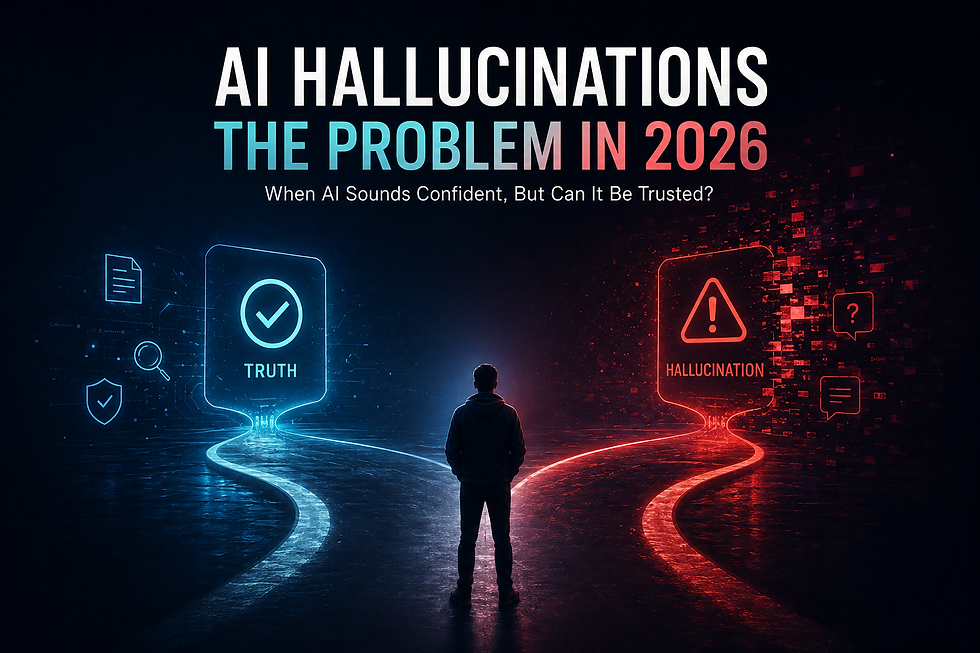
By 2026, the discussion around AI will no longer focus on whether it works. It clearly does. The more troubling question is whether it knows when it doesn’t.
AI hallucinations, which are when systems produce confident but incorrect outputs, were once seen as a temporary issue, a flaw of early models that could be fixed. But that idea is beginning to change. We now understand that hallucination is not just an error on top of intelligence; it arises from the fundamental way these systems are created.
Large language models do not “know” information as humans do. They make predictions. Each response is a set of probabilities over various sequences, influenced by patterns learned from extensive data. Most of the time, those probabilities match reality. But when they don’t, the system acts without hesitation. It doesn’t show uncertainty unless it is specifically designed to do so. It simply generates the most statistically likely answer and presents it with the same confidence as a verified fact.
This leads to a unique type of failure. Traditional systems fail visibly. They crash, generate errors, or stop working. AI fails invisibly. It keeps the conversation going, fills in gaps, and makes uncertainty seem coherent. Because people tend to trust fluid communication, the more natural a response sounds, the more believable it seems—even if it is completely made up.
What makes this exceptionally risky in 2026 is not the presence of hallucinations, but their context. AI is no longer limited to chat interfaces or experimental tools. It is integrated into workflows, decision-making processes, content creation, and even early research efforts. When hallucinations happen in isolation, they are merely mistakes. When they happen in systems people depend on, they distort reality.
There is a basic response to this issue: improve the models, refine the data, add safeguards, and use retrieval systems to ground responses in verified information. To some extent, these methods help. They lower the chances of hallucination. But they do not remove the root cause. As long as systems are designed to generate instead of verify, the chance of fabrication remains built in.
This leads to a troubling realization. As AI advances, it may become harder to tell what is real and what is statistically convincing. This is not because the system is purposely misleading, but because its idea of “truth” is inherently different. It prioritizes coherence over accuracy.
This shift changes responsibility in a significant way. Initially, developers bore the responsibility for addressing hallucinations. Now, it is increasingly falling to users to spot them. Unfortunately, humans are not naturally suited for this at scale. Checking each output defeats the purpose of using AI in the first place. Trust becomes both essential and risky.
There is also a deeper issue that goes beyond individual mistakes. If AI-generated content starts to fill the data that future models are trained on, hallucinations do not just stay isolated—they multiply. Fabricated inaccuracies can build on themselves, creating feedback loops where false information gains weight simply because it appears often. In that case, hallucination stops being a sporadic glitch and begins to look like an alternative reality.
So, the question is no longer, “Can we fix AI hallucinations?” but “What does it mean to work in a system where hallucinations are unavoidable?” One potential solution is transparency—systems that show confidence levels, reveal sources, or clearly acknowledge uncertainty. Another option is hybrid models that mix generation with verification. But even these solutions rely on the idea that uncertainty can always be clearly defined and communicated.
The harder truth is that intelligence—whether human or artificial—has always worked with incomplete information. AI has intensified this situation and spread it worldwide. Hallucinations do not create uncertainty; they increase it.
By 2026, the challenge is not just technical. It is also behavioral. How do people adjust to systems that are often correct, sometimes wrong, and are never aware of the distinction? How can trust be built in something that cannot inherently tell the difference between knowledge and approximation?
Perhaps the most unsettling part is this: as AI becomes more woven into daily decision-making, the boundary between help and influence begins to blur. When systems that shape understanding can produce convincing falsehoods, even by accident, the risk extends beyond misinformation to misdirection at scale.
In that light, AI hallucinations are not merely a problem to solve. They are a condition to grasp. The future of AI may not depend on completely eliminating them, but on learning to navigate a world where truth and probability are no longer perfectly aligned.
Comments