.png)
Chatbots to AI Operators
- metamindswork
- May 2
- 5 min read

Updated: May 10
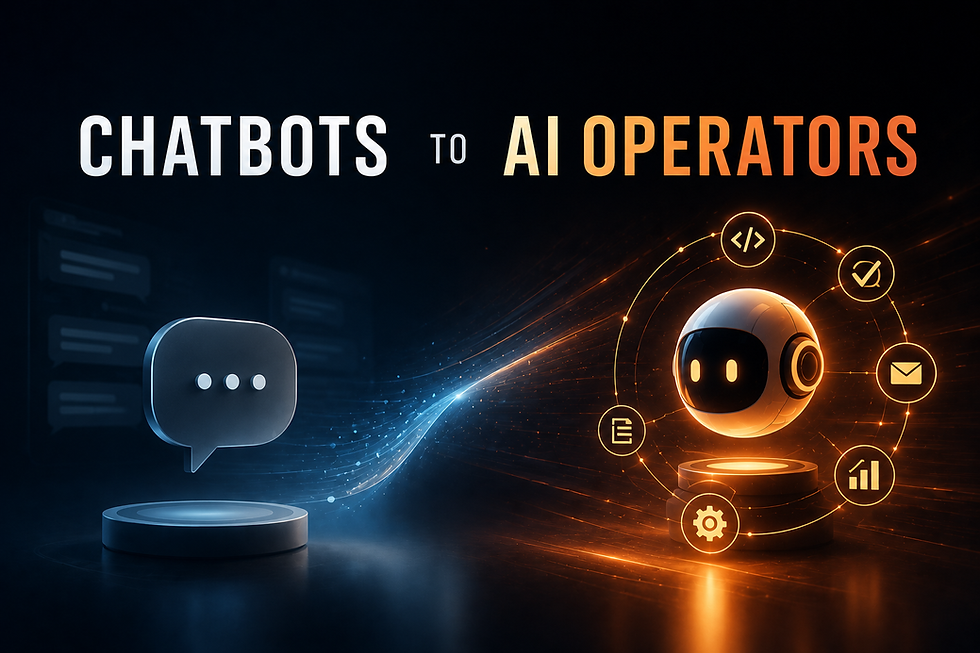
Chatbots were never meant to be powerful. They were meant to be useful. In the past, systems were designed to provide answers, fetch information, and help with basic tasks. They acted as a bridge between people and technology, but they didn't really take part in the action themselves. It was simple: you asked a question, and they gave you a response. The line between what the system could do and what it couldn't was clear-cut. That boundary is dissolving. The shift from basic chatbots to more advanced AI operators isn't just about having better conversations. It's about taking action. These new systems don't just give you answers, they actually do things for you - like writing code, managing tasks, working with other software, and making decisions in certain situations. They're not just helping you out; they're working on your behalf, making things happen. It seems like a logical next step. If artificial intelligence can come up with a solution, why not put it into action? If it can write an email, why not send it off? If it can look at data and figure out what it means, why not do something with that information? Each of these steps makes things easier and faster, closing the gap between thinking about doing something and actually doing it. When you take away the things that slow us down, it can actually change how people work and interact in some pretty subtle ways. When we start taking action, having someone watch over our shoulder isn't always necessary. It's not that it's not needed, but it can slow us down. Think of an AI system that waits for approval at every single step - it's efficient, but it's not the best way to do things. So, we design systems to take the lead, but still within certain boundaries and rules that the user sets. This way, the system can work quickly and make decisions on its own, without needing constant supervision. It's all about finding a balance between being careful and being efficient. This is where things take a big turn. The person using the system doesn't have complete control over every little thing anymore. Instead, they set goals, and the system figures out how to get there. This is a different way of working together. Instead of just giving someone a task to do, it's about giving them the power to make decisions. An AI operator does more than just follow orders - it actually understands what you want it to do. It takes big tasks and breaks them down into smaller ones, figures out what's most important, and adjusts its plan if something changes. This makes it seem more like a partner than just a machine. And while it's not human, it can work way faster and longer than people can, without ever getting tired. The challenge is not capability. It is alignment. When we give a system the freedom to make decisions, even with some rules in place, it can still face situations where it needs to use its judgment. The big question is, what's the best course of action? What are we willing to compromise on? And how do we deal with uncertainty? These aren't just technical issues; they're about understanding the context, considering our values, and being okay with a little ambiguity. It's not always clear-cut, and that's what makes it challenging. We need to think about what's important to us and what we're willing to accept, even if it's not perfect. And while AI can approximate decision-making, it does not inherently understand consequences in the way humans do. It optimizes for objectives, but those objectives may not capture the full complexity of real-world impact. The way mistakes happen is changing. When a chatbot gives a wrong answer, it's a small problem that can be fixed, ignored, or checked. But when an AI system takes a wrong action, it can cause a lot of trouble. For example, sending the wrong email, changing the wrong data, or running the wrong command - these aren't just mistakes; they have big consequences. They can start a chain reaction that's hard to stop. As systems become more autonomous, the cost of mistakes increases. But even with all the risks, it's hard to stop the move towards using AI to run things. The benefits are clear to see. Jobs that used to take hours to finish can now be done in just a few minutes. This makes work easier, decisions faster, and processes simpler from start to finish. And over time, reliance grows. As systems take over handling tasks, people start to focus more on overseeing things. When systems make decisions, humans set the objectives. This changes what it means to be an expert - instead of knowing how to do something, it's about knowing what needs to be done. But even this distinction may not remain stable. As AI systems get smarter, they start to suggest what we should do next. They find opportunities, recommend plans, and even propose actions before we ask them to. This means the system doesn't just react to what we want, but it also tries to guess what we want before we say it. When humans and systems work together, things change. They don't just follow orders; they connect and work as a team. The person in charge doesn't lose control, but they share it with the system. Instead of just telling the system what to do, decisions come from how they interact with each other. And this raises a fundamental question: if a system can both define and execute actions, where does the human role begin and end? The future is not set in stone; it's going to be different depending on the situation, the type of work, and the people involved. But one thing is for sure, we're heading in a certain direction. Right now, AI is helping humans get things done, but soon it will be working right alongside us. And who knows, maybe one day it will be able to do some things on its own, at least in certain areas. The transition from chatbots to AI operators is not just a technological upgrade. It is a shift in how work, control, and decision-making are structured. And like most big changes, this one doesn't happen overnight. It happens bit by bit, with small tweaks that seem like a good idea at the time - until eventually, they add up to something entirely new. Now we have to think about what we can do with AI. It's really up to us to decide how it works for us. We have the power to choose what we let it do, and that's what makes all the difference.
Comments