.png)
Shadow AI Risk
- metamindswork
- May 9
- 4 min read

Updated: May 10
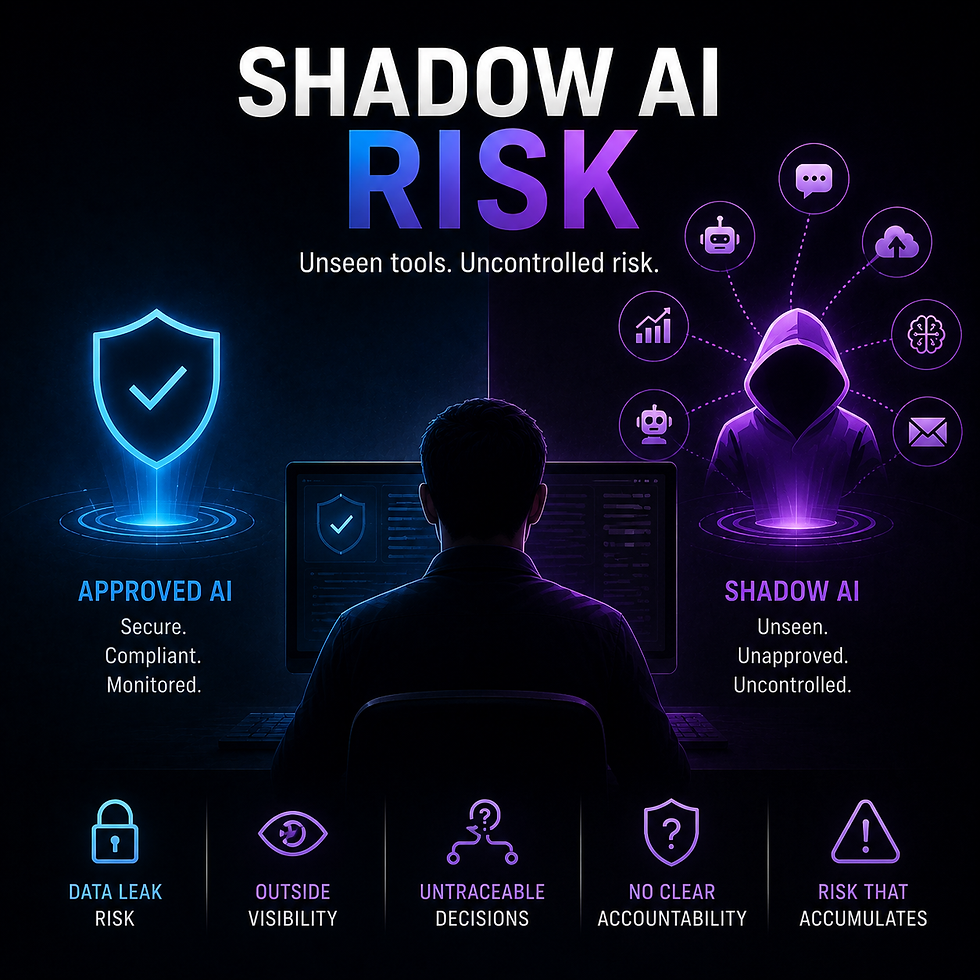
There was a time when the biggest risk in technology was what systems could do. Today, the more subtle risk is where those systems exist without being seen. "Shadow AI" isn't just one tool or platform; it's more like a way of doing things. It happens when employees use AI models without going through the official channels. Teams might also connect outside systems without getting approval, and individuals could use automated tools to make decisions, handle workflows, and even communicate with each other - all without the organization really knowing what's going on. This doesn't usually happen because someone is trying to cause trouble, but because it's just easier that way. And that’s what makes it difficult to control. Companies put a lot of money into AI systems that are approved and secure, and that follow the rules. But these systems can be slow and hard to use, with a lot of controls and limitations. That's where shadow AI comes in - it's fast, flexible, and gets the job done right away. For the person using it, it feels like a big time-saver. But when you look at the bigger picture, it can cause problems because it doesn't follow the same rules as the approved systems. It's like a shortcut that can lead to things getting disconnected and harder to manage. The real issue isn’t that these tools exist. It’s that they operate outside visibility. When an employee uses an external AI model to summarize internal documents, generate reports, or even assist in decision-making, data begins to move beyond controlled boundaries. Sensitive information may be processed by systems that store, learn from, or expose it in ways that are not fully transparent. And because these interactions are often small and routine, they rarely trigger immediate concern. But risk doesn’t always scale linearly. It accumulates. Using unauthorized AI just once might not be a big deal. But when it happens thousands of times, across different teams and processes, it can create a complex web of hidden connections. As a result, decisions start to depend on information from systems that haven't been properly checked. Some processes get partially automated by tools that aren't being watched. Over time, the way the organization works starts to include things it doesn't fully understand or control. This can lead to problems that are hard to see and fix. For example, if many teams are using different AI tools without permission, it can be hard to keep track of how they are being used and what impact they are having. This can make it difficult to make good decisions and can even lead to mistakes that affect the whole organization. This can create a strange kind of weakness, not exactly a breakdown, but more like a slow movement away from where you're supposed to be. Shadow AI is different from traditional cybersecurity threats because it's not something you can see coming from the outside. It's more like a problem that grows from within, making it hard to pinpoint exactly where things are going wrong. You can't just defend one spot, because the issue is spread out and tricky to track. The system doesn't suddenly stop working, but it starts to make less sense over time. Information moves around in unexpected ways, making it tough to know if the results are accurate. As a result, it becomes really difficult to figure out who or what is responsible when something goes wrong. There is also a deeper shift in how decisions are made. When AI tools are used informally, without standardized validation, their outputs may carry implicit authority. A generated summary, a suggested strategy, a predicted outcome—these can influence decisions even when their accuracy is uncertain. And because the process is not formally integrated, there is no clear mechanism to audit or challenge it. In this context, shadow AI doesn't just bring technical problems; it also creates a whole different kind of risk - the risk of not really understanding how the system is creating knowledge. This is what we call epistemic risk, and it's a big deal because it makes us question the whole process of how information is being put together inside the system. Companies usually try to limit access to AI tools by blocking them, making strict rules, and controlling things more tightly. But this approach has a major flaw: people really want to use AI because it makes their work more efficient. As long as AI helps people get things done faster and better, they will find ways to use it, no matter what. Trying to restrict AI might just make it harder to see what's going on, and people might start using it in secret instead of stopping altogether. So the challenge becomes less about prevention and more about integration. How do you bring shadow AI into the light without removing the very flexibility that made it useful? How do you create systems that are both controlled and adaptable? The answer to this question isn't simple, because shadow AI is more than just a technology issue - it's also about how people behave when they use powerful tools without any rules to follow. This means that shadow AI shows us how individuals interact with these tools and what happens when they have a lot of power at their fingertips, but not a lot of guidance on how to use it properly. This is where things get really interesting, because the risk starts to become more about ideas and less about just technical stuff. You see, companies are set up to work in a certain way, where everything is planned out, can be tracked, and is under control. But then Shadow AI comes along and throws a wrench into all that by introducing things that don't follow the usual rules, but still have an impact on what happens. It's like, what happens when the things that are supposed to be in charge aren't really in charge anymore? What emerges is not a failure of systems, but a mismatch between how systems are designed and how they are actually used. The unsettling part is that shadow AI doesn’t announce itself. It doesn’t trigger alarms or cause immediate disruption. It integrates quietly, shaping workflows, influencing decisions, and altering data flows in ways that are difficult to observe in real time. By the time its effects become visible, they are often already embedded. The thing about risk is that it's not really about AI working secretly, but more about how the systems that use AI can create hidden problems.
Comments