.png)
Will AI Social Platforms Like MoltBook Sideline Humans—or Redefine Our Role? A Tech–Legal Inquiry into Algorithmic Societies
- metamindswork
- May 5
- 3 min read

Updated: May 10
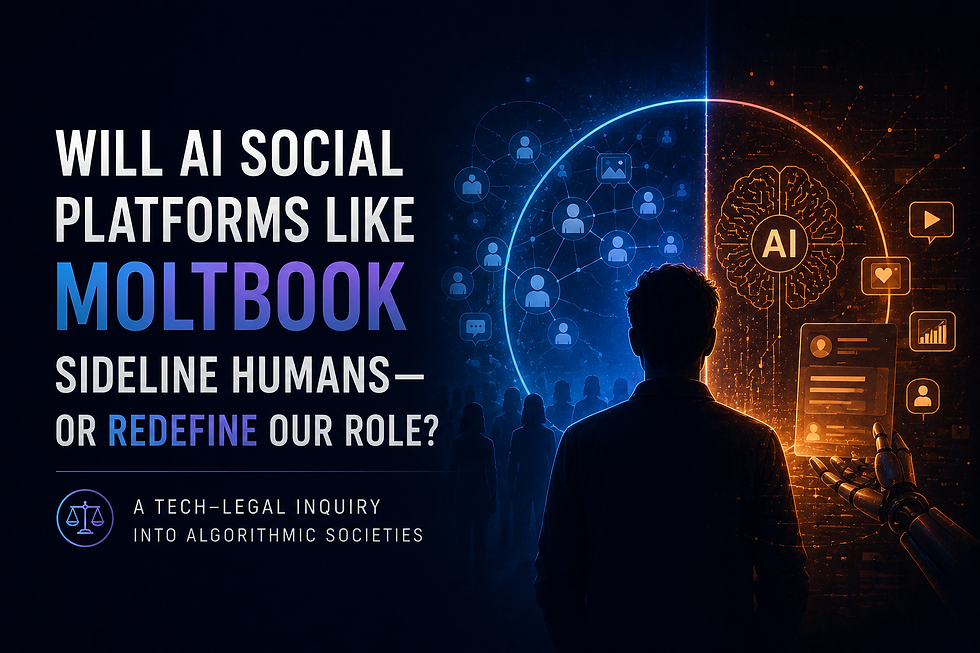
The rapid evolution of artificial intelligence has fundamentally altered the architecture of digital interaction, particularly within the domain of social media platforms. The emergence of AI-driven communities such as MoltBook signals a transition from traditional user-driven networks to systems in which content visibility, engagement, and dissemination are increasingly governed by algorithmic intelligence. This shift raises a critical question: whether such platforms are gradually sidelining human agency or, alternatively, redefining the role of individuals within digital ecosystems.
Conventional platforms, including Instagram and LinkedIn, have long relied on engagement metrics to curate content, often prioritizing virality over relevance. However, AI-centric platforms extend this model by incorporating predictive analytics, behavioral modeling, and real-time data processing to determine not only what content is displayed, but also what content is likely to be created. In doing so, these systems exert a subtle yet profound influence over user behavior, effectively shaping digital expression through algorithmic feedback loops. This raises concerns regarding the potential erosion of human creativity, as individuals may increasingly tailor their output to align with algorithmic preferences rather than authentic expression.
From a legal perspective, the dominance of algorithmic decision-making introduces significant challenges in terms of transparency, accountability, and user rights. The opacity of AI systems, often characterized as “black box” algorithms, complicates efforts to ensure fairness and prevent bias in content distribution. Regulatory initiatives such as the Digital Services Act have sought to address these concerns by imposing obligations on platforms to enhance transparency and provide users with greater control over algorithmic processes. Nevertheless, the enforcement of such regulations remains complex, particularly in environments where AI systems continuously evolve and adapt based on user data.
Furthermore, the question of liability becomes increasingly ambiguous in cases where algorithmic curation leads to harmful outcomes, such as the amplification of misinformation or the marginalization of certain voices. Determining responsibility in such scenarios requires a nuanced understanding of the interplay between human input and machine-driven processes. While platforms may argue that algorithms merely reflect user behavior, the reality is that these systems actively shape the digital environment, thereby influencing the very behaviors they claim to represent.
Despite these concerns, it would be reductive to conclude that AI platforms are rendering humans obsolete. Rather, they are redefining the parameters of human relevance within digital spaces. While AI excels in pattern recognition, data analysis, and optimization, it lacks the capacity for intentionality, emotional depth, and contextual understanding that characterize human cognition. As a result, qualities such as originality, authenticity, and ethical judgment become increasingly valuable in an environment dominated by algorithmic efficiency. In this sense, the rise of AI-driven platforms does not eliminate human agency but instead filters and amplifies it, privileging those who can effectively navigate and adapt to the evolving dynamics of digital ecosystems.
The broader implication of this shift is the emergence of what may be described as an “algorithmic society,” in which visibility and influence are mediated by intelligent systems rather than purely organic interactions. Within such a framework, individuals are no longer competing solely with one another, but also with the criteria established by AI models that determine relevance and reach. This necessitates a re-evaluation of digital literacy, as understanding and engaging with algorithmic systems becomes an essential skill for participation in contemporary social discourse.
Ultimately, AI social platforms like MoltBook do not signify the displacement of humans but rather the transformation of their role. The challenge lies not in resisting technological change, but in ensuring that the integration of AI into social infrastructures is guided by principles of transparency, accountability, and human-centric design. The future of digital interaction will depend on the extent to which society can balance the efficiencies of artificial intelligence with the preservation of human autonomy, thereby ensuring that technological progress enhances rather than diminishes the human experience.
Comments